Buzzings from a quilter who bumbles her way through life!
Showing posts with label history. Show all posts

Wednesday, July 29, 2015

A Topsy-Turvy World


At an estate sale last weekend, I found this little treasure. I love dolls, and handmade dolls are even more special in my eyes than "store bought"! This little vintage gal could easily be older than I am and was very well made. The thing that is special about her is that she has two personalities.

 She is a type of "dolly conjoined twin" called a "topsy-turvy doll". 

 Here you can see that if you flip her over you will find her other half.
 There are a couple of theories about how these interesting dolls originated. It is known that they were first seen before the mid 1800's. These were the days of slavery, when white plantation babies were cared for by black slave women. 
One theory is that these dolls allowed little slave girls to practice caring for babies of different races, just like their mamas did.
Another theory is that little black slave girls were not allowed to have a white baby doll and this toy allowed them to flip their baby over to the "legal" side when being watched.
(There are probably more theories out there, but these are the two that are hotly debated.) 
I would love to know who first came up with this idea. Wasn't she clever!!! Perhaps she just wanted her daughter to have a fun and interesting toy!
There have been many variations of this concept over the years. When I was little, there was a popular Little Red Riding Hood with Grandma at the other end. If you flipped Grandma's bonnet over, the wolf's face was behind it.
Another idea was the sleeping baby on one end and the awake baby on the other.
A quick Google search will yield many variations.
In the meantime, I will enjoy owning this piece of Americana. I'll think of the busy fingers sewing away for someone they loved dearly. I am inspired to make my own version now. 
Watch for it! I've already started!

Thursday, March 5, 2015

A "New" Old Quilt to Cherish


We returned late yesterday from East Texas, where we attended my grandmother's funeral.  I returned with a treasure! My grandmother made this quilt and quilted it by hand. It appears to be of scraps from whatever she had - feedsacks, clothing, scraps from sewing, perhaps even an old curtain or two. This quilt makes me want to cut up old clothing and make a quilt!


 She most likely made this during the late 20's or early 30's. This quilt was made to keep her family warm. If a piece wasn't big enough, she pieced it. She didn't worry too much about mixing colors and prints. The batting inside was made from East Texas cotton that she carded herself. One year I picked a little cotton that was left in my brother in law's field and after spending HOURS picking seeds out, I decided I was no purist. Buying commercial batting is just fine with me!


My grandmother became an excellent seamstress.

 I also came home with two photos of myself in new dresses. Do you remember the thrill of new clothing when you were little? 

Me, in 1955, showing off a new dress. I was 5 years old.


My sister, on the left, and I showing off new dotted swiss dresses. I remember twirling around in these until my daddy made us stop! We're probably about aged 5 and 8 here. (The date on the back of the photo is 1958 or 59.)(Isn't my sister adorable!) We were beside my grandmama's garage here, I believe.

I'm going to go cuddle up in my Grandmama's quilt now! Stay warm!


Monday, January 28, 2013

A Family Treasure!


If you've followed my blog for a while, you will know how "in love" I am with vintage items. This weekend, we went to visit my husband's Aunt Wilma. I came home with a family treasure - quilt blocks hand made by his Aunt Rubye! Aunt Rubye has been gone for about 20 years now. She died in her 90's. When she was living, she was a master with the needle! Everything she made was perfection! (This is the same aunt who made a living embroidering monograms for Neiman-Marcus during the Depression years!)
 There are 11 squares here, all hand appliqued and embroidered on muslin. They look like Spring to me!!
A close up. Although the vase appears to be crooked, it is because I have not pressed the block and there is a fold through the center.

The bolt of pillow ticking was packed with it, so we assume she planned to use it for the backing. There is no date on these. She started sewing as a young girl at the turn of the century, but I am assuming these blocks were from the 1930's (when she made several quilts) or the 1940's. I think the backing fabric is from later.

I'm not sure how I will put this together. I assume she planned a 12th block, but after counting them 5 times, I don't think I missed one. It might be that one will become a pillow (or cushion as my European and British friends would say). I think it will make a gorgeous quilt if I don't mess it up! I will set it aside and think about the perfect setting for these blocks.
Have you seen this pattern before? If so, do you have any information about it? 
Until next time....
 Bee Blessed!
 

Friday, March 2, 2012

Antique Treasures


 My mother passed this quilt block along to me this week. It was made by my great grandmother, Minnie Duncan, who was born in 1877 and died in 1968. We shared a birthday. I don't remember her as an active person. My main memory of her was a story she told me when I was little.  She lived in Northeast Texas which is populated with pine forests called the Piney Woods. She and her sister were walking in the woods behind their house when they came across a bear. (I'll bet you didn't know there were bears in Texas!) Their faithful dog ran at the bear while my great grandmother and her sister ran away. The dog was killed, but the sisters lived to tell the story. 
I'm not sure yet what I will do with this little block, but I love it because it is a mystery. The colors are strange. I thought at first that maybe what I'm seeing as pink had been red and had faded, but behind the seams the fabric is still pink. (Could it be that it fades even without sunlight? I don't know.) There is pink in the print at the corners also. The inside block (the aqua, red, and pink) are sewn by hand. The blue and print are added by machine. Could it be that these were made by two different people? Did she make the inside block before she was blessed with a sewing machine? 

The quilt on the left is also very old but is from my husband's side of the family. It was a utility quilt - made only for warmth and not for looks. It is literally falling apart. My husband's Aunt Rubye gave it to us to use as a pallet for our boys. It is so ragged, the insides have become visible. It was a treasure all this time, for inside is an extremely old quilt that is so worn, there is only a ghost image of it left. 


The cotton batting was hand carded and all stitching is by hand. I have no idea who might have made the quilt inside, but the outer layer was from the 1930's or 40's, so the inside quilt was much older than that. It turns out people often used a worn quilt as the batting for a new quilt. After all, it was all about making good use of what you had. Aunt Rubye was the daughter of a pioneer Texas preacher (who happened to be my husband's granddaddy), so there is a chance it was a gift and not made by family. We'll never know, but even in the condition it's in now, it's a treasure. 


post signature 


Friday, January 27, 2012

Depression Era Quilt Top?


My husband's sweet cousins (thank you, DD and Linda!) found this pretty quilt top at an estate sale and put it aside for me. It has the characteristic "bubble gum" pink of the Depression era and many of the fabrics in the Dresden plate design appear to be from flour or feed sacks. 
 Although the sashing is machine sewn, the Dresden plate design is sewn with hand stitching. 
I am going to set this aside for a little while and really think about how it should be quilted. I wish there had been a little tag along with it telling who made it. I imagine the hours and hours put into it. I tend to make up my own back story if I haven't been given one, so I imagine some little Texas grandmother sewing these blocks while sitting on the porch in a rocking chair. (She had to get out of the stifling hot house on those summer days, so she sat in the shade with a breeze on her face.) As she pulled out each little carefully cut shape, she thought about where she got the fabric. It might have started out as a flour sack or a sack of chicken feed. It probably was made into a little child's romper before being put aside to be cut up for quilt fabric. The same hands that sewed these designs so carefully, also shelled peas and shucked corn. She kneaded bread at least once a week and often thrilled the "men folk" with her pies. She always wore an apron and spent many hours hanging the laundry on a line outside the kitchen door.  Her babies were born at home and a few of them died there. When her sons marched off to war, she waited weeks and sometimes months to hear from them, each day with a prayer for their safe return. She was "soft as a kitten" and "tough as nails". How sad that her family didn't think of all this when they decided this top was not something they wanted to keep. 
This makes me want to finish all my UFO's and get labels on them!  I think I may put a note on each one of them, telling a little about why I started it and maybe even why I didn't finish! 
post signature

Monday, January 16, 2012

My Very First Quilt Tops - 33 years ago


I was looking through my UFO box this morning and came across my two oldest "unfinished objects". 
When my two oldest sons were very young (about 2 yrs. and 4 yrs. old) I attempted to make quilt tops for them.
 
Quilting was not yet a popular thing in the late 70's. I didn't know anyone who quilted except my husband's aunt. She didn't live nearby, so I couldn't go to her for advice. AND, machine quilting wasn't acceptable at this point. You mailed off your top to someone who would hand quilt it for you and mail it back. I couldn't afford to do that at this point in my life, so they stayed unquilted.
 
I didn't have a pattern or even a book to tell me how to sew a quilt top, so I just came up with my own designs and dove in. I did have a couple of quilts passed down to me, so I knew most quilts had blocks and sashing (although I had no idea of the terminology). The fabric available then was a polyester/cotton blend, so that's what I used along with scraps I had been given.

I had no idea of the things to really watch out for when putting my top together. I didn't know what made a quilt top neat and nicely sewn. 


Now I know that my blocks and sashing should line up!


my poor little fish is upside down, but that's not the worst of his problems!


My blocks should be the same size!

And I know now to not cut the points off my triangles!


Despite these problems that seem so obvious now, I put these unquilted tops on my boy's beds and let them enjoy them. They have a few spots and stains and I had to repair several seams. 

Now......do I quilt them in their current condition or take them apart and rework them before quilting? The "persnickety" among you will say "REWORK", but could it be the true value of these sad little quilt tops is that a young mother made an attempt to provide something special for her little boys despite her limitations? Would reworking them destroy the evidence of that? I'll have to think about this one - maybe for another 33 years!
post signature

Monday, September 26, 2011

Vintage Quilt and Embroidery Patterns

Quilters and Embroiderers have used patterns for a very long time. This is the way they shared designs and passed them on.  In 1974, my husband and I visited his Aunt Rubye. She was a remarkable "needleworker" who made a living at one time by embroidering monograms on shirts for Neiman-Marcus! (There were enough oil millionaires back then for her to do that!) She was also an accomplished quilter and seamstress. She was born before the turn of the century and learned as a young girl how to sew and embroider. On this visit, Aunt Rubye showed me her "workshop" - a creative jumble of project areas for crafting, sewing, and quilting. She pulled out her embroidery patterns and when she saw my jaw drop over the old patterns, she gave me a few. (I was only 24 at the time and these treasures seemed ancient to me!) I have treasured them over the years. They are extremely special to me, not only because they are old, but because they were hers.


 These embroidery patterns have been transferred to old brown paper grocery bags. They have designs that appear to have been from around the turn of the century. The paper appears to be waxed or oiled, which I'm sure has kept it from falling apart.


 I have no idea when these patterns were produced, but they are Butterick Transfer Patterns and I do know that Butterick made transfer patterns between 1863 and the early to mid 1930's..They are pattern #10436. I was unable to find out anything more than that.


The  patterns below early examples from the Joseph Walker Co. These patterns are from  the late 1930's. The first was designed to iron onto children's clothing, crib covers, pillows, aprons, etc. to "give an embroidered effect". The second was an iron on transfer meant to be embroidered.

The Vogart pattern below was from after 1959, since it included Hawaii and Alaska as states.

Below are some Laura Wheeler Designs. These were sold through newspapers. The first one below is from 1946. The second one (with the baby design) is from 1960.


The last one I will show is also a pattern ordered from the newspaper. The address label on the envelope has been cut from the newspaper and filled out by the person who ordered it. This is from 1976. That was the year when quilting here in the United States had a resurgence. This was the Bi-Centennial year for this country and many "old" crafts were being revisited for fairs, school projects, demonstrations, etc. This soon carried over into home decor. I remember a popular wallpaper  I wanted that had reproductions of old Sears & Roebuck catalog pages from the 1800's. Quilt patterns came out in magazines and many women started quilting again because there was a new appreciation for old crafts. The pattern here is one for a State Bird quilt. 


I really love OLD things like this! I don't know if it's the history behind them that intrigues me, or the "romantic" ideas I form in my imagination about the people using them and the times they lived in. Some day maybe I'll make a quilt with some of these embroidery patterns worked up in the centers of blocks. If nothing else, I feel inspired when I look through them and that's worth a lot to me.

post signature

Thursday, June 30, 2011

The History of the Button

Button card from Sears & Roebuck, 1961

For some reason, I'm fascinated with buttons! I've even put them on quilts. I love the shapes, colors, sizes.....the sound of them in a glass jar, the stories they've been around for...you name it. I have a jar of buttons that I bought at a garage sale once. It had many old buttons in it. Then I inherited my grandmother's and great grandmother's button jar. I love those buttons! My great grandmother was married in 1906, so there could be some really old buttons in there!
Sampling from my grandmother and great grandmother's button jar
Many were clipped off of shirts and dresses during the Depression to be used again and again. You didn't waste anything! Some of them still have a small part of the original shirt or coat or dress still attached!
More from the button jar


Buttons have not been around forever. The earliest buttons that were used on clothing were from the Indus Islands about 3000 years ago. They were made of seashells and had holes so that they could be sewn to clothing. They were used more for ornamentation than anything else. It was not until the 13th century that some brilliant German came up with the use of buttons as a means of fastening a garment closed! (Before that, you were either sewn into your clothes or tied in!) 
Buttons became like jewelry. Artists created buttons that were beautiful, one of kind pieces. The wealthy showed off by using many buttons on their clothing. There were even royal decrees limiting the type of buttons you wore to those suited to your social class! 
By the 17th and 18th centuries, buttons were being produced in many different materials and shapes. Beautiful buttons were produced in France and Germany, but England soon became a front runner in the production of buttons. Buttons could depict hunting scenes, portraits, family crests, or anything else that an artist might paint, carve, mold, or embroider on a button. 
As the American revolution neared, the colonists showed their American patriotism by buying only American made buttons instead of the British buttons they were accustomed to. Buttons were crafted from wood, pewter, brass, and  papier mache. Paul Revere made buttons in silver. Phineas Pratt, a well known maker of piano keys, made buttons in ivory. 
In the mid 1800's, button production was in its "Golden Age". Mass production meant that it was possible to produce buttons in quantities never seen before. Not long after this, the sewing machine became a common tool of many homemakers who needed buttons for the garments they produced at home. The button was now readily affordable, but the artistry was disappearing.
From 1860 to 1900, the Charm String became popular among young girls. They started by stringing a large button on a string. This was the "touch button". After this they added buttons from friends and relatives. The goal was to string 1000 buttons on their string. When the 1000th button went on, their true love was to soon come and "sweep them off their feet". (Of course, in some circles, it became a popularity game and it was said that if the 1000th button went on, the girl would be a spinster.) So much for superstition!
Buttons have stuck around despite the invention of zippers and hook and loop tape! (I'm glad we don't have to button our shoes anymore, but that's a different story.)
I think you'll always see a jar of buttons in my sewing room!

Yesterday, Annie of Ruby Slipperz had a great post about buttons that you can read   here  . I had this post written already. Take a look at her buttons and read what she has to say about those she has inherited, too. Buttons often have warm memories attached to them! You might take another look at what you have in your button jar!

Don't forget about the giveaway! You have until July 6 at midnight, CST.  To enter, go to this page  
post signature

Thursday, May 5, 2011

Mayo Feliz El 5!

"Folklorica Dancers" by Darla Royal (7" x 9")

Today is Cinco de Mayo, the unofficial holiday celebrating the Mexican army's victory over the French in 1862, during the Mexican/American war. I have nothing against the French and I'm not Mexican, but in areas where there is a large Mexican population, this day has become a day to celebrate the Mexican culture and heritage. There are sales in shops, parties in homes, and even parades in cities.
You might enjoy seeing some watercolors of Folklorica dancers on my sister's blog. She had an entire series of them. You can see them on Doodling in My Mind. She has been doing a series of paintings, challenging herself to do one watercolor a day. Since she teaches high school art and the end of the school year is always hectic, this has been difficult. She has pulled it off beautifully, though! 


I was inspired to pull out these fabrics from my stash. They are not new fabrics. Some are older than others. I collected them because they reminded me of the Mexican influence. The bright colors, the free form designs, the bold contrasts all appeal to me. 
The black fabric in the background is from the "Folklorica" collection by Julie Paschkis of Beginning Fabrics (2009). The four fabrics beside the bowl are part of that collection. I love it so much, I haven't been able to cut into it. 
The fabrics in the bowl are unidentified. Most are old. The yellow "fiesta" fabric is "Salsa Picante" , designed by Lorilynn Simms for Robert Kaufman fabrics. (unknown year)
Some day I plan on making a bright, happy Mexican influenced quilt. Until then, I just enjoy taking the fabrics out and looking at them!

Happy Cinco de Mayo!

Tuesday, January 11, 2011

Our Lives Changed by a Scoundrel!

My Singer Featherweight
If you're a quilter or you sew anything on a home sewing machine, you may be surprised to know a few little facts. 
First of all, Elias Howe was not the first person to invent a sewing machine. There are patents as early as the last half of the 18th century for machines that sewed with a needle through either fabric or leather. Unfortunately, none were particularly successful and some didn't even work. That is until 1830 when a Frenchman named Thimonnier invented a successful machine for sewing caps. He was almost killed by a mob of tailors who accused him of trying to put them out of business. 


In 1834 Walter Hunt invented a successful sewing machine, but did not pursue a patent because he was afraid it might cause unemployment.


In 1846 Elias Howe patented his sewing machine. 


THEN, in 1850 another sewing machine was patented. Elias Howe sued for patent infringement and won. The "infringer" was Isaac Singer. But this was not the reason he was called a scoundrel. He was a well known actor of his day and  "dabbled" in anything that would make money. He was also a pretty good inventor. He was approached about coming up with a more "user friendly" sewing machine.He replied, "You want to do away with the only thing that keeps women quiet - their sewing!" He did it anyway, although he stepped on a few toes (those of Howe) in doing it.  His machine was too expensive to be widely accepted, so he came up with a genius plan that we still suffer from today. He devised the "installment plan". This is the little idea that made it possible for women to be able to afford to have sewing machines in their homes. And yet, this is not why I call him a scoundrel. 


Isaac Singer became very successful. In fact, he was so successful he maintained 5 households with a wife and children in each! He was also known to have knocked his "real" wife and daughter unconscious when they dared to confront him. 


I would love to see his face today when groups of quilters at workshops and classes sit with their little Singer Featherweights doing "the only thing that keeps women quiet - sewing" --- only they are NOT QUIET, but talking a blue streak! 


Tuesday, July 27, 2010

The Right Needle for the Job

Choosing the best needle for the work you're doing is not as easy as just finding a needle among the pins in a pin cushion. Any needle may take the thread through the fabric, but the right needle will make this job much easier.
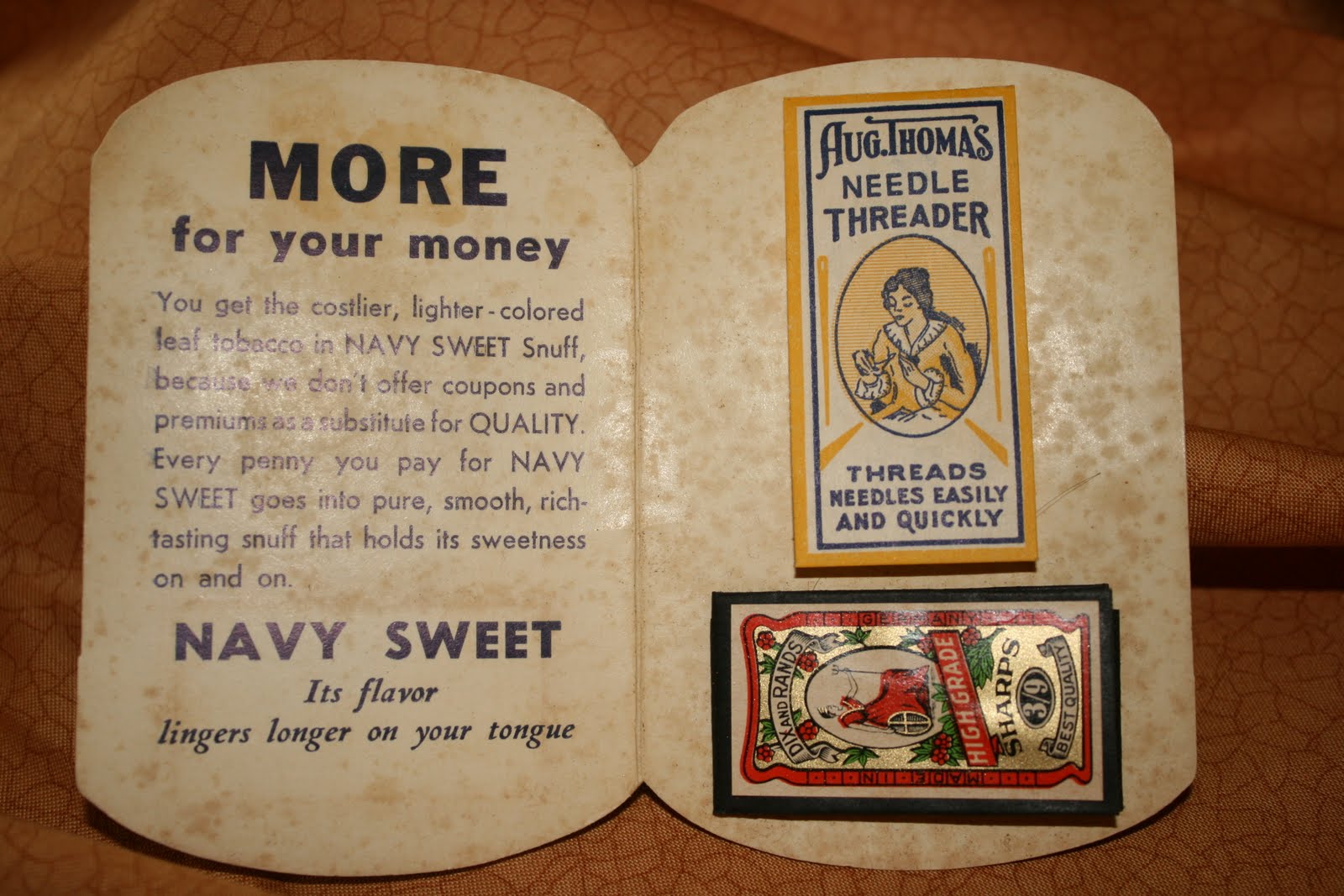
Needles have been around for almost as long as people have worn some type of clothing or sewn a shelter from animal hides. Early needles were made from bone, or in the case of Native Americans in the southwest, made from the spines of the Agave plant. It amazes me just how ingenious people can be! Needles have been an important staple for a long time. I have an old sewing kit that I found in a box of sewing supplies bought with a treadle machine at an auction. I think it was given out as part of Army gear during one of the wars. There is actually a square cut out of the army drab fabric pocket at the bottom of the case. I would love to know why. Did the soldier have to patch his uniform? In this same box, I found an old needle case advertising snuff.


   Modern needles are made from steel or stainless steel and go through a meticulous process of cutting, grinding, stamping, punching, heating, cooling, plating, and polishing. The more tapered and polished a needle is, the better quality it will be.( English and European needles tend to be higher quality than those made in China. Japanese needles can also be higher quality.) Cheaper needles tend to have burrs that will break threads and make the entire process of sewing more difficult. If your fingers are getting tired while doing hand sewing, change to a higher quality needle and see if you can tell a difference. By the way, needles will get dull after much use, so they do not last forever! Because early needles, even those used by your great grandmothers and sometimes your grandmothers, were very expensive and rusted easily, they were run through emery (aluminum oxide) after use and kept in wool. I remember the little "strawberry" at the top of my mother's old pin cushion had a gray powder in it. I'm assuming this was the emery. Modern needles are plated and make this unnecessary.

When trying to buy needles you might be overwhelmed with the different types and sizes. First of all, the size matters to the use. In needles, the larger the size number the smaller and shorter the needle. I can't remember the exact method of sizing, but a simplified way to remember this is to determine how many wires will fit inside a certain diameter ring. (Similar to measuring spaghetti in one of those rings designed for that purpose.) Of course, the thinner the wire, the more wires it will take to fill the ring. If it takes 10 wires to fill the ring, the wire is a #10. If the wire is thicker, it might only take 6 wires, so those thicker wires would be a #6. Of course, I'm sure people who KNOW what I'm talking about are rolling their eyes at my oversimplification, but it works for me. The exception to this rule is the sewing machine needle. They are sized in reverse of this. The bigger the number, the bigger the needle. I don't know why!

In addition to different sizes, there are different types of needles. Here is a simple chart that might help you decide which you need:
Sharps - medium length, general sewing 


Applique - longer length, finer shaft for applique


Quilting(Betweens) - very short length for hand quilting. The shorter the needle, the smaller the stitches you can get.

Milliners - designed for hat making, but because of its longer length and thinner shaft, it is sometimes used in needle turned applique or for basting.

There are other types of needles out there that are not used as often in quilting such as ball point needles used for sewing knits, tapestry needles for crewel embroidery, and darners used for basting and darning ( I'm not sure how many people actually darn anymore!)


Using good sewing machine needles is important also. Some sewing machine manufacturers put out their own brand of needles (such as Bernina) and I'm sure they are really good. I use Schmetz machine needles because I know they are high quality and readily available.

If you are having a hard time deciding which type of needle to use, ask around in your local quilt shop. They generally carry good quality needles and may have some good advice for you.
Related Posts Plugin for WordPress, Blogger...